"Just DCA" is some of the most repeated advice in crypto. Dollar-cost averaging (DCA) means investing a fixed amount at regular intervals instead of all at once. Recurring purchases, the "buy £50 every week" features offered by exchanges and on-chain apps, are the most common way to put it into practice.
The two terms are often used interchangeably, but they are not the same thing. DCA is a strategy; a recurring purchase is a tool. This guide explains how DCA works in crypto, compares the tools, and is clear about what DCA can and cannot do.
What dollar-cost averaging is
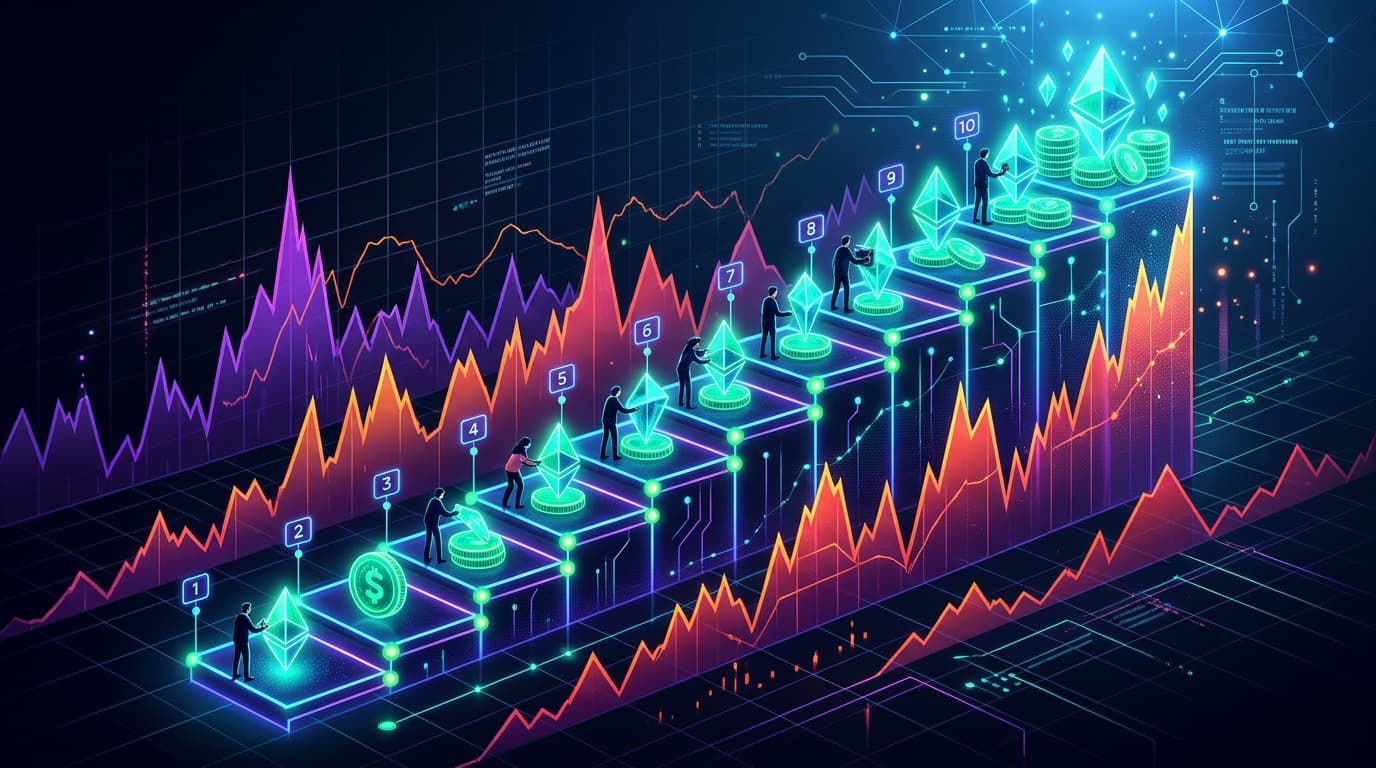
The US SEC's investor education site defines dollar-cost averaging as investing equal amounts at regular intervals regardless of price. Because the amount is fixed, you automatically buy more units when the price is low and fewer when it is high.
The main benefits are behavioural rather than mathematical:
you avoid the stress, and frequent mistakes, of trying to time the market;
you reduce the risk of putting everything in just before a sharp fall;
you build a habit that fits a regular income.
A worked example
Suppose you invest 100 USDC into a token every week for four weeks, and the price moves like this. (Prices are illustrative.)
Week | Price | Tokens bought with 100 USDC |
|---|---|---|
1 | 20 | 5.00 |
2 | 16 | 6.25 |
3 | 10 | 10.00 |
4 | 20 | 5.00 |
Total | 26.25 tokens for 400 USDC |
Your average cost is 400 ÷ 26.25 ≈ 15.24 per token, below the simple average of the four prices (16.50), because the fixed amount bought more tokens when the price was low. At the final price of 20, your 26.25 tokens are worth 525 USDC.
Had you invested all 400 USDC in week 1 at 20, you would hold exactly 20 tokens, worth 400 USDC at the end. DCA did better here because the price dipped and recovered. In a market that rises steadily, investing everything at the start does better; in one that falls steadily, DCA still loses money, just more slowly.
DCA is not a guarantee
It is worth being blunt about this:
DCA does not protect you from an asset going to zero. Averaging into a failing token just means losing in instalments.
DCA does not guarantee a profit or beat lump-sum investing; in a market that rises over your buying period, money invested later simply buys at higher prices.
DCA does reduce timing risk and emotional decision-making, which is valuable in a market as volatile as crypto.
The most important decision is still what you are buying and how much risk you can afford, not how you schedule the purchases.
The tools: recurring purchases
On centralised exchanges
Most large exchanges and many fintech apps let you schedule recurring buys from a bank card or account balance: daily, weekly or monthly.
Pros: convenient, linked directly to your bank, no wallet management needed. Watch for: card or instant-buy fees and spreads that can be much higher than trading fees on the exchange's own order book; and the fact that the exchange holds your assets until you withdraw them.
On-chain, from your own wallet
On Solana, tools such as Jupiter's DCA feature (labelled Recurring on its website for a period) let you lock in a total amount and have it split into smaller swaps executed automatically on a schedule. At the time of writing, Jupiter's documentation describes:
the first purchase executing immediately and the rest following at your chosen interval;
a minimum of $10 per individual purchase;
an optional price range, so purchases outside your minimum and maximum price are skipped and retried at the next interval;
fees of 0.03% for stablecoin pairs or 0.1% for other pairs, plus a variable routing fee, charged as each purchase executes;
no pause button: to stop an order you cancel it, and unspent funds return to your wallet.
Pros: you keep custody, can DCA into tokens not listed on exchanges, and fees can be low. Watch for: you must already hold the stablecoin or token you are spending; each swap is subject to on-chain liquidity and price impact; and individual purchases can fail and retry.
For the mechanics of each swap, see How Solana Token Swaps Work.
DCA vs limit orders vs lump sum
Approach | Best when… | Main drawback |
|---|---|---|
Lump sum | You have conviction and a long horizon, and can tolerate a sharp drop right after buying | Timing risk |
DCA / recurring buys | You want discipline and to spread timing risk | Can underperform in steadily rising markets; still exposed to bad assets |
Limit orders | You have specific price levels in mind | May never fill; see What Are Limit Orders in Crypto Trading? |
Many people combine them: a steady DCA plan plus occasional limit orders at levels they have decided in advance.
Practical tips
Choose the asset first. DCA is a way to buy, not a reason to buy.
Pick an amount and frequency you can sustain for months without needing the money.
Compare total costs, including spreads and card fees, not just headline percentages.
Keep records of every purchase. Each DCA buy has its own price and date, which matters for calculating gains and for tax in many countries. See How to Track and Manage a Cryptocurrency Portfolio.
Review periodically, not constantly. Check whether your plan still fits your situation, and avoid stopping and starting based on short-term price moves.
Conclusion
Dollar-cost averaging is a simple, disciplined way to build a position over time by investing fixed amounts on a schedule; recurring purchase features on exchanges and on-chain tools like Jupiter's DCA are ways to automate it. DCA reduces timing risk and emotional mistakes, but it does not turn a bad investment into a good one or guarantee returns. Use it for assets you have researched, with money you can leave alone.
Sources and further reading
Educational content, not financial advice. This article explains how things work; it is not a recommendation to buy, sell or hold any asset. Crypto assets are volatile and high-risk, smart contracts can fail, and you can lose all of the money you put in. Do your own research, check official sources, and never share your seed phrase. See our full disclaimer.