Once you hold more than one or two assets, in more than one place, it gets surprisingly hard to answer simple questions: How much do I have? What did I pay? Am I taking more risk than I intended? A good tracking system answers those questions, makes tax time far less painful and helps you make calmer decisions.
This guide sets out a practical way to track and manage a crypto portfolio, whether you hold a few tokens in one wallet or assets spread across wallets, exchanges and DeFi protocols.
Step 1: map where your assets are
Start with a simple inventory:
Self-custody wallets (for example Phantom), with their public addresses;
Centralised exchange accounts;
DeFi positions: staked SOL, liquid staking tokens, lending deposits, liquidity pool positions and open orders;
Hardware wallets and any long-term "cold" storage.
Write down each location and what it is for. Many people use a simple structure: a cold wallet for long-term holdings, a hot wallet for everyday use, and a separate wallet for experiments.
Step 2: track with read-only tools
You can see a self-custody wallet's balances simply by entering its public address into a block explorer or portfolio tracker. That is all a tracker needs.
Never give a tracking app, website or support agent your recovery phrase or private key. No legitimate tracker requires them.
Wallets such as Phantom show balances and recent activity for each address; explorers such as Solscan show full transaction histories.
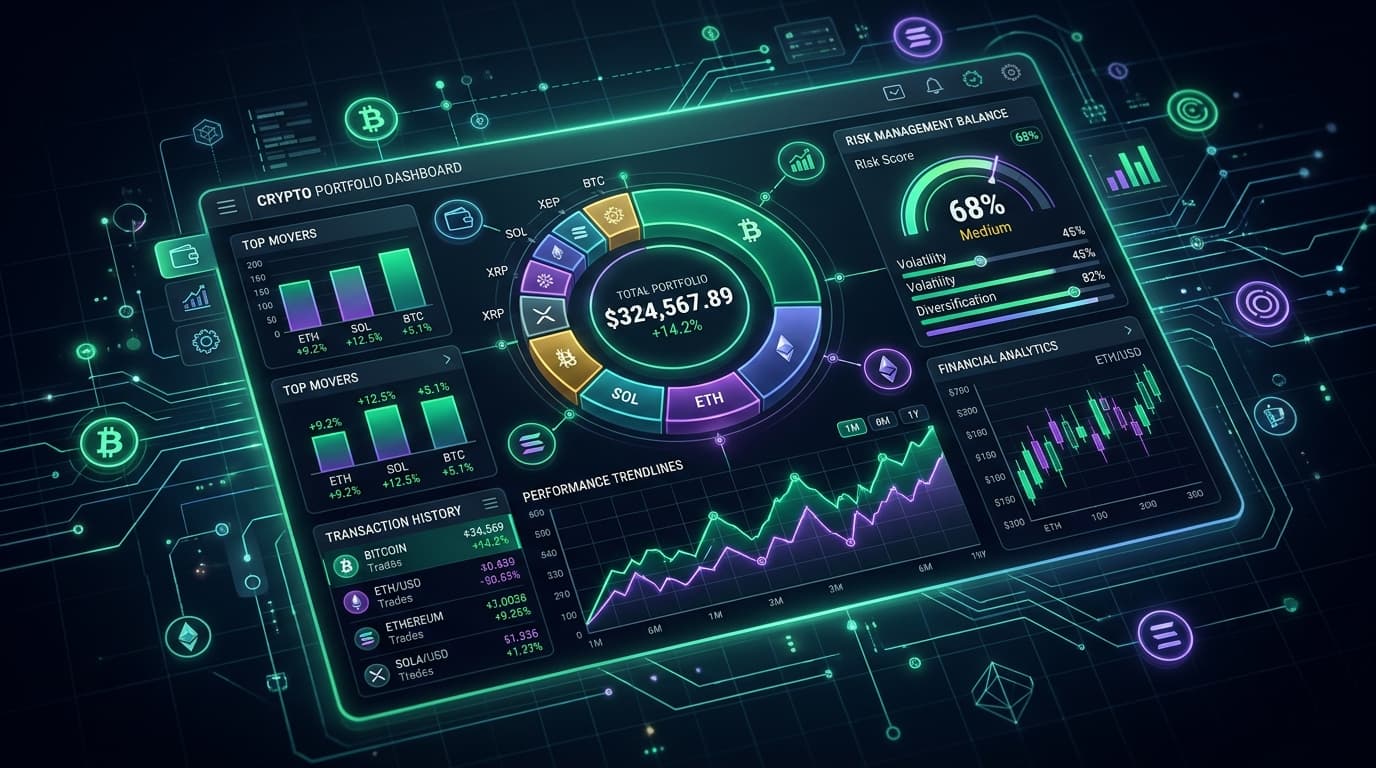
Portfolio dashboards from aggregators and analytics sites can combine several Solana addresses, including DeFi positions.
For exchanges, use read-only API keys if a tool supports them, with trading and withdrawal permissions disabled.
Remember that dashboards depend on price feeds and protocol integrations; small or new tokens may be priced incorrectly or not at all.
Step 3: keep your own records
Dashboards show what you hold now. For tax and decision-making, you also need to know what you paid. Keep a record, even a spreadsheet, of every acquisition and disposal:
Date | Action | Asset | Amount | Price (in your currency) | Fees | Location | Transaction ID |
|---|---|---|---|---|---|---|---|
2026-03-02 | Buy | SOL | 2.0 | £180.00 total | £1.20 | Exchange A | (order ID) |
2026-03-09 | Swap | SOL → USDC | 0.5 SOL | (value at the time) | 0.000005 SOL | Wallet 1 | (signature) |
(Illustrative entries.)
Useful habits:
save the transaction signature for on-chain activity; it lets you verify everything later on an explorer;
export exchange histories regularly, since accounts can be closed and data can become harder to retrieve;
note staking rewards, airdrops and DeFi income as they arrive, as these may be treated as income in some countries;
record why you made each trade; it is invaluable when reviewing your decisions.
A word on tax
Many tax authorities treat crypto disposals, including swapping one token for another, as taxable events, and some treat staking or DeFi rewards as income. Rules differ widely by country. In the UK, HM Revenue & Customs publishes a detailed cryptoassets manual; in the US, the IRS publishes guidance on digital assets. Specialist crypto tax software can import wallet and exchange histories, but it relies on the records you provide. If your situation is complex, consult a qualified tax adviser.
Step 4: decide how much risk you want
Tracking is only useful if it informs decisions. A few principles:
Size positions by what you can afford to lose. Speculative tokens, such as those described in What Are Solana Meme Coins?, deserve a much smaller share than established assets.
Set target allocations. For example: a core holding, a stablecoin reserve and a small speculative slice. The right mix is personal; the point is to decide it deliberately.
Account for hidden concentration. Liquid staking tokens, wrapped assets and LP positions often depend on the same underlying asset or protocol. Five tokens can still be one bet.
Know your exposures to platforms, not just assets: how much depends on one exchange, one wallet or one DeFi protocol?
Step 5: rebalance with a rule
Prices drift, and so does your allocation. Rebalancing means selling some of what has grown beyond its target and buying what has fallen below it. Two common approaches:
Calendar rebalancing: review monthly or quarterly.
Threshold rebalancing: act only when an asset drifts beyond a set band, such as five percentage points from target.
Each trade has costs and may have tax consequences, so avoid rebalancing too often. Tools like limit orders and recurring buys can help you execute calmly; see What Are Limit Orders in Crypto Trading? and DCA vs Recurring Crypto Purchases.
Step 6: protect what you track
Portfolio management is pointless if the assets are stolen.
Store recovery phrases offline, never in screenshots or cloud notes.
Consider a hardware wallet for long-term holdings.
Use separate wallets for long-term holdings and for interacting with new apps.
Enable strong, unique passwords and app-based two-factor authentication on exchange accounts; avoid SMS codes where possible.
Review connected apps and open DeFi positions periodically, and close what you no longer use.
Be wary of unsolicited tokens or NFTs in your wallet; interacting with them can be a trap.
Our Phantom Wallet: Complete Beginner's Guide covers wallet security step by step.
A simple monthly routine
Update your holdings view across all wallets and accounts.
Reconcile any new transactions with your records.
Check allocations against your targets and rebalance if a threshold is breached.
Review open orders, DeFi positions and connected apps.
Back up exported histories somewhere safe.
Twenty minutes a month is usually enough.
Conclusion
A well-managed crypto portfolio rests on three things: a clear map of where your assets are, accurate records of what you did and why, and deliberate rules for risk and rebalancing, all tracked with read-only tools that never need your keys. It is not glamorous, but it is what separates a portfolio you control from a collection of positions you hope will work out.
Sources and further reading
Educational content, not financial advice. This article explains how things work; it is not a recommendation to buy, sell or hold any asset. Crypto assets are volatile and high-risk, smart contracts can fail, and you can lose all of the money you put in. Do your own research, check official sources, and never share your seed phrase. See our full disclaimer.