When you buy crypto with a simple "swap" or "buy" button, you accept whatever the market price is at that moment. A limit order works the other way round: you choose the price, and the order only executes if the market reaches it. Limit orders are one of the most useful tools for controlling what you pay, and one of the most misunderstood.
Order types in one minute
Order type | What you specify | What you get |
|---|---|---|
Market order | Amount only | Fills immediately at the best available price, which may be worse than expected in fast or thin markets |
Limit order | Amount and a price | Fills only at your price or better, but may never fill |
Stop order | A trigger price | Becomes active once the trigger is hit, typically to limit losses or catch breakouts |
The US Securities and Exchange Commission's investor education site describes the core trade-off well: a market order prioritises execution, a limit order prioritises price.
How a limit order works
A buy limit is placed below the current price: "buy 2 SOL if the price falls to 90".
A sell limit is placed above the current price: "sell 2 SOL if the price rises to 130".
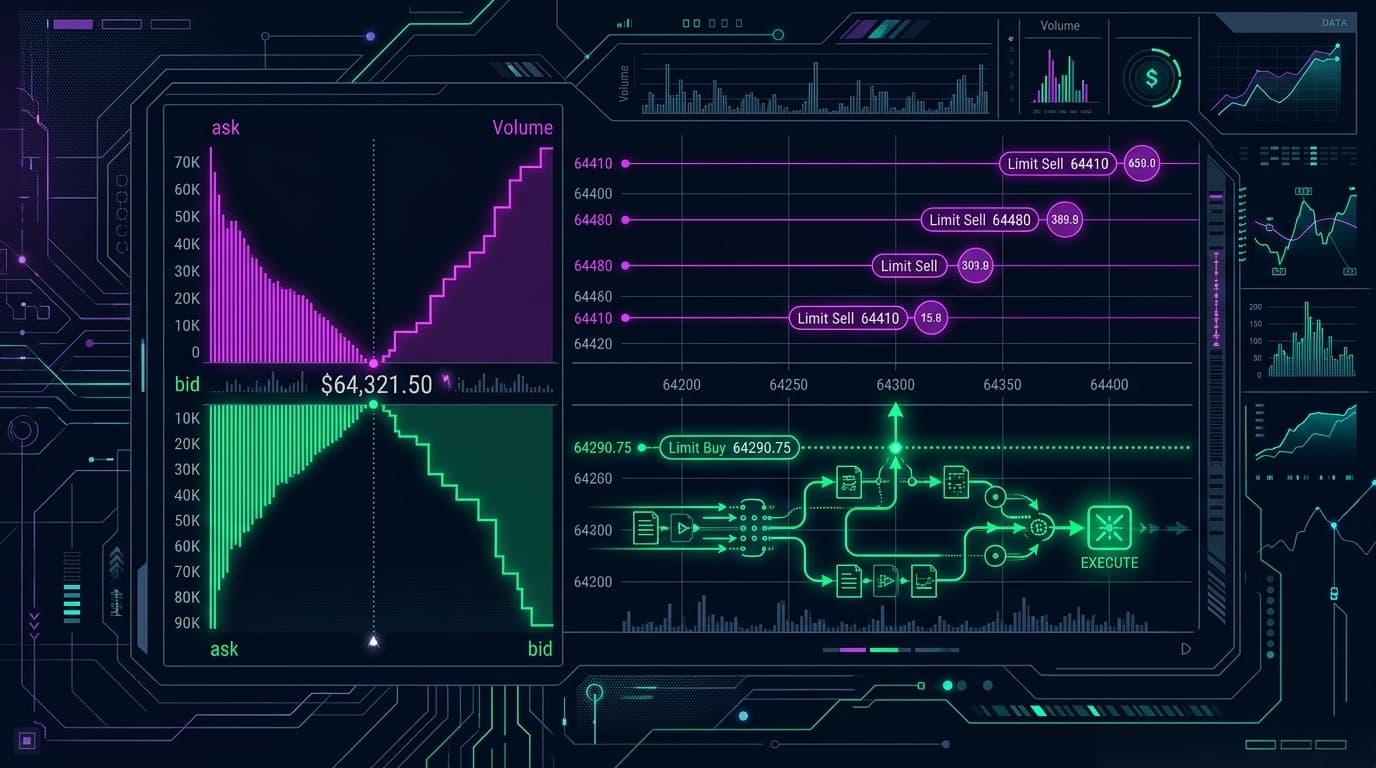
If the market reaches your price, the order fills at that price or better. If it never does, the order sits unfilled until it expires or you cancel it.
A worked example
Suppose SOL trades at 100 USDC (an illustrative price). You would like to buy, but only at 92 or less. You place a buy limit for 5 SOL at 92 USDC, locking up 460 USDC. Two days later the price dips to 91.50 and your order fills at 92 or slightly better. If the price had instead risen to 120, you would have missed out entirely. That is the cost of insisting on your price.
Limit orders on centralised exchanges
On centralised exchanges, limit orders sit in an order book alongside everyone else's. Because your order adds liquidity that others can trade against, exchanges often classify you as a maker and may charge a lower fee than takers who trade instantly against existing orders. Orders can fill partially: you might get 3 of your 5 SOL if only that much is offered at your price.
Limit orders on Solana
Solana's speed makes on-chain limit orders practical, and you will find two broad approaches.
On-chain order books
Some Solana exchanges, such as Phoenix, run a full order book as an on-chain program. Your limit order rests in the book and is matched against incoming orders, much as on a centralised exchange, but with settlement on the blockchain and your funds held by the program rather than a company.
Keeper-based limit orders
Other tools, including Jupiter's limit orders, do not use an order book. Instead:
You set a trigger price and amount; your tokens are locked in an on-chain escrow.
A network of automated keepers watches market prices.
When your trigger is reached, a keeper executes a swap on your behalf through available liquidity, aiming for your requested price.
Orders can fill partially if liquidity is thin, and unfilled orders expire after the period you choose, returning your tokens.
Fees are typically charged only when an order executes. At the time of writing, Jupiter's documentation lists a base fee of 0.03% for stablecoin pairs and 0.1% for other pairs, plus a variable routing fee. See What Is Jupiter Exchange? for more.
When limit orders are useful
Buying dips or selling into strength without watching the screen.
Avoiding slippage on large or illiquid trades, where a market order would push the price against you. (Compare with the price-impact examples in Understanding Liquidity Pools.)
Taking profit at a level decided calmly in advance, rather than in the heat of the moment.
Reducing exposure to front-running, because you are not broadcasting a market swap with a wide slippage tolerance.
Pitfalls and risks
No guarantee of execution. Fast moves can skip past your price, especially on keeper-based systems where execution depends on available liquidity at the moment.
Partial fills. Plan for the possibility that only part of your order executes.
Opportunity cost. Funds locked in an open order cannot be used elsewhere, and the market may run away from you.
Stale orders. An order set weeks ago may no longer reflect your view. Review open orders regularly and use sensible expiries.
Stop orders are not guarantees. In a crash, a stop-loss may fill well below your trigger, or, on some on-chain systems, not at all if the price moves beyond your slippage tolerance.
Token risk does not disappear. A perfectly placed limit order on a fake or rugged token is still a loss. Verify tokens first using How to Analyse a Solana Token Before Investing.
Limit orders and strategy
Limit orders are a tool, not a strategy. They can complement a disciplined plan, such as buying gradually with DCA vs Recurring Crypto Purchases or taking profits at pre-set levels, but they cannot make a poor decision good. Decide in advance how much you are prepared to risk, and size positions accordingly.
Conclusion
A limit order lets you trade at your price rather than the market's, at the cost of possibly not trading at all. On Solana you can use them through on-chain order books or keeper-based tools that execute swaps when your trigger is reached. Used with clear expiries, verified tokens and realistic expectations about fills, they are one of the simplest ways to bring discipline to crypto trading.
Sources and further reading
Educational content, not financial advice. This article explains how things work; it is not a recommendation to buy, sell or hold any asset. Crypto assets are volatile and high-risk, smart contracts can fail, and you can lose all of the money you put in. Do your own research, check official sources, and never share your seed phrase. See our full disclaimer.